


15 Jul Silent Sentinel
Silent Sentinel
by Ann Havemeyer
A silent sentinel sits in the Great Hall of the Norfolk Library. From its lofty pedestal on the mezzanine, the portrait bust of Abraham Lincoln has kept watch for more than a century on library activities: readers nestled in the comfort of leather armchairs, knitters enjoying lively conversation in front of a fire; children engaged in the art of puppetry; poetry readings and book discussions; foreign films and chamber concerts. But while silent, this sentinel has a story to tell.
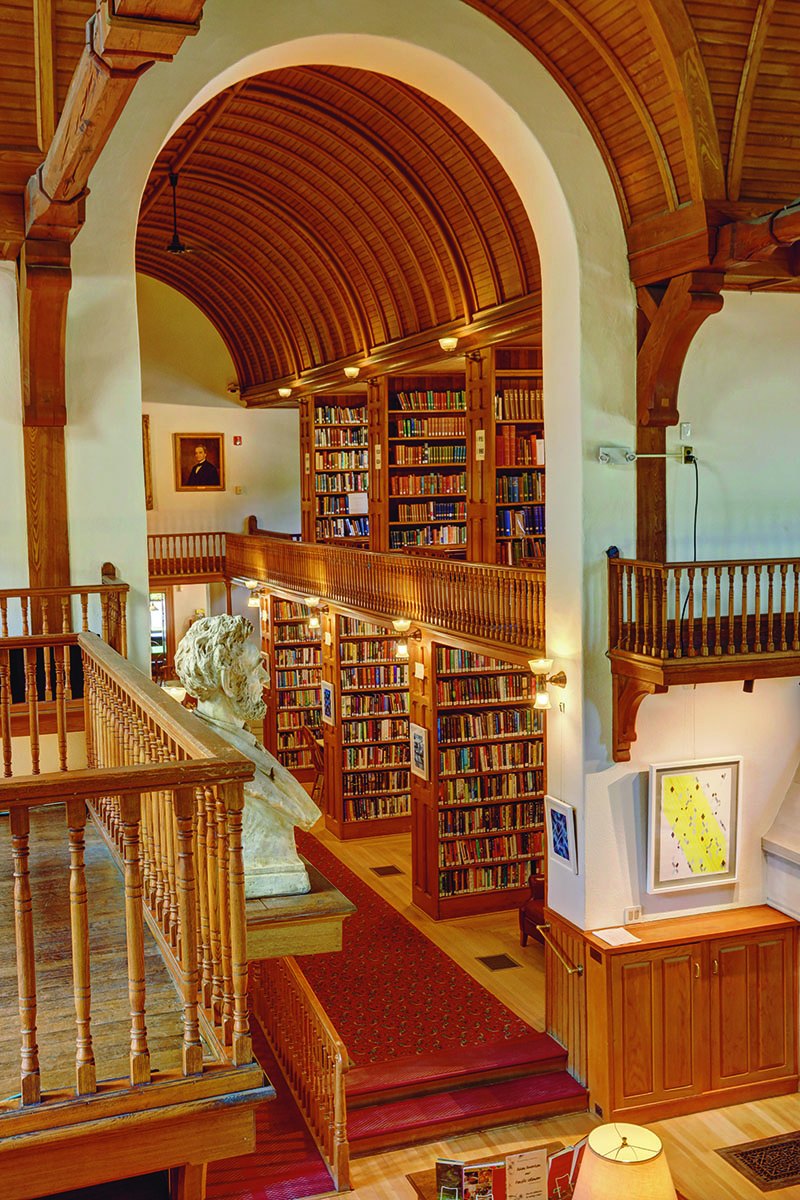
The portrait bust was created in 1909, the centennial of the Abraham Lincoln’s birth. It was among many artistic depictions of Lincoln that the public eagerly consumed. The popularity of the sixteenth President soared dramatically with the celebration of the centennial. On February 12 that year, people gathered nationwide to honor Lincoln, who fought to preserve the Union. Throughout the country, in big cities and small towns, there were parades, concerts, school programs, and speeches.
At eight o’clock in the morning, the forts around New York Harbor, the battleships in port, and the National Guard field batteries fired a salute in honor of Abraham Lincoln. At noon the Gettysburg Address was read in New York City’s public schools. Booker T. Washington marked the day with a speech to the Republican Club at the Waldorf-Astoria. Boston’s celebrations included U.S. Senator Henry Cabot Lodge addressing a joint session of the Massachusetts House and Senate and Julia Ward Howe, author of “The Battle Hymn of the Republic,” presenting the new poem “A Vision.” In Chicago, the city where Abraham Lincoln received the Republican nomination for president in 1860, Mayor Fred A. Busse exhorted citizens to dedicate a whole week to the study of the life and words of the President. In the tiny town of Hodgenville, Kentucky, visitors flocked to the Sinking Spring farm where Lincoln was born and drank from a stream that flowed on the property.
In Norfolk, Alice Eldridge Bridgman sponsored a Lincoln’s Day Concert at the Congregational Church, continuing a tradition she had started in 1900. Alice believed that Lincoln should never be overshadowed by Washington and chose these concerts as her way of paying tribute to his memory. She sponsored annual Lincoln’s Day Concerts through 1923.
Since his assassination in 1865, Abraham Lincoln’s adulation as “The Great Emancipator” who saved the Union and ended slavery had grown. While he played a critical role in ending American chattel slavery through the Emancipation Proclamation and the 13th Amendment, today we know that the reality is more complicated. The idealization of Lincoln in the wake of his death and the victory of the United States in the Civil War increasingly marginalized the most important participants in the saga of emancipation: the formerly enslaved people themselves and the vast network of abolitionists, soldiers, and Black people who worked to end slavery both during and before the Civil War. It also obscured Lincoln’s interactions with Indigenous people, whose suffering increased as a result of U.S. Army actions in the Civil War.
But in 1909, the celebration of the centennial elevated Lincoln into the “pantheon of greatness.” In Washington, Congress authorized minting the new Lincoln penny, designed by Victor David Brenner. To the left of Lincoln’s face was the word “Liberty,” and to the right was the date 1909. The reverse is the legendary “Wheat Ears” design that honors America’s agricultural heritage.
Statues and busts, paintings and portraits multiplied, culminating in the Lincoln Memorial (1914-1922) in Washington D.C. The Library’s bust was carved by Raffaello Gironi and offered for sale by the Boston Sculpture Company in 1909. The Boston Sculpture Company’s 1914 catalog describes it as the best likeness of Lincoln available: “All the others are poor imitations of ours.”
The “best likeness” of Lincoln, however, is the cast or mask that Leonard Wells Volk made of Lincoln’s face in the spring of 1860. Volk, a stonecutter, studied to become a sculptor in Italy through the generosity of his wife’s cousin, Illinois Senator Stephen A. Douglas. Douglas introduced Volk to Abraham Lincoln in 1858, and Lincoln agreed to pose for the sculptor. Two years later, while Lincoln was in Chicago on legal business, he sat for Volk in his studio. In order to eliminate the need for several sittings, the artist made a life mask, which became the basis for later artistic depictions of the President. It is now in the collection of the Smithsonian Institution.
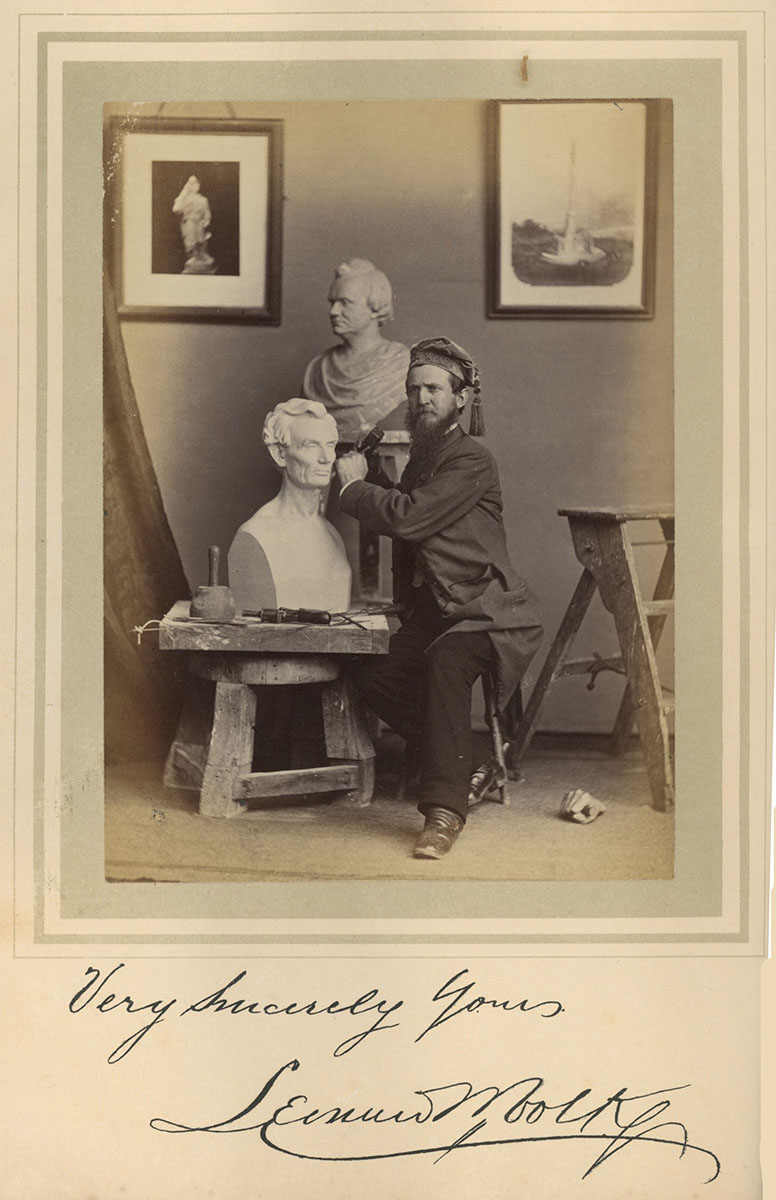
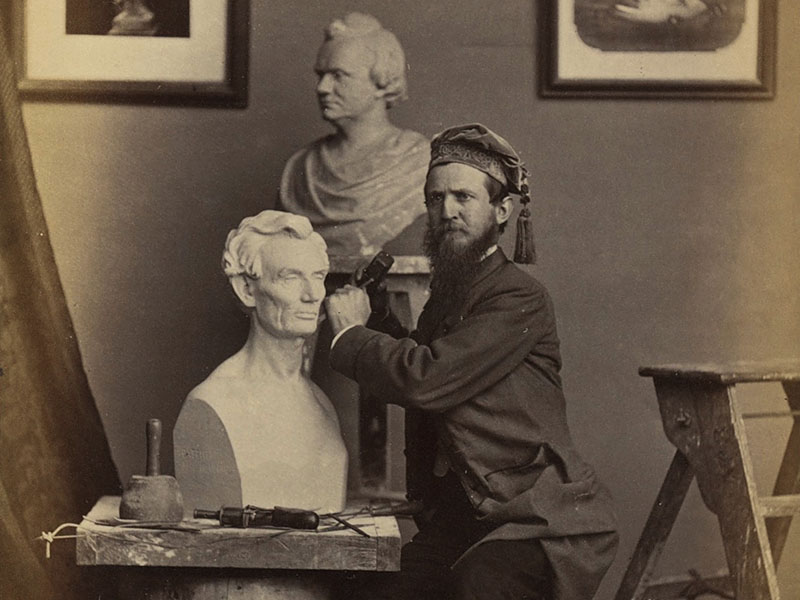
In 1868, Leonard Volk posed with popular versions of his Lincoln and Douglas busts
In an article in Century Illustrated Monthly Magazine (Dec. 1881), Leonard Volk described in detail how his life mask of Lincoln was made: “He sat naturally in the chair when I made the cast, and saw every move I made in a mirror opposite, as I put the plaster on without interference with his eyesight or his free breathing through his nostrils. It was about an hour before the mold was ready to be removed, and being all in one piece, with both ears perfectly taken, it clung pretty hard, as the cheek-bones were higher than the jaws at the lobe of the ear. He bent his head low and took hold of the mold, and gradually worked it off without breaking or injury.”
Lincoln later recalled that the experience was “anything but agreeable.” Yet, with self-deprecating humor, he declared upon seeing Volk’s cast, there is “the animal himself!” The mask was but one step toward sculpting his entire head. After the sittings, during which Volk took measurements of Lincoln’s head and torso, Volk cast the face mask model in plaster, making a mold from which multiple copies could be made. He then sculpted a portrait bust, which became a landmark in American sculpture.
Volk’s sculpture portrays Lincoln with simple naturalism as a vigorous man, deep in thought. It helped establish Lincoln’s image among voters eager to know more about the presidential candidate. As Dr. Ian Hunt, head of acquisitions for the Abraham Lincoln Presidential Library, said: “The image captured by Volk dispelled criticism of the future president as awkward, homely or weak. Volk’s work instead conveyed a sense of strength, integrity and character which certainly helped propel Lincoln into the White House.”
Among the Lincoln busts that Volk sculpted is one that he presented to Mary Lincoln after her husband won the Republican nomination for president on May 17, 1860. The Lincolns displayed it in their Springfield home until they moved to Washington, D.C., in February 1861. That bust is now in the Abraham Lincoln Presidential Library and Museum, in Springfield, Illinois, donated in 2022 by MK Pritzker, the wife of the Illinois Governor, to inspire unity among Americans. In an announcement of the gift, Mrs. Pritzker said:
“President Lincoln’s vision for national unity amid poisonous and violent division rings true today more than any other time in my lifetime. This iconic bust of President Lincoln is valuable for more than just the history it represents; it is valuable for the future that it inspires.”
In his Second Inaugural Address, delivered on March 4, 1865, Abraham Lincoln stressed the need for healing and peace rather than retribution. The President appealed to the nation’s best ideals “with malice toward none, with charity for all” in the pursuit of a more perfect, more just, and more enduring Union.
Sorry, the comment form is closed at this time.