



15 Jul A Tribute to Isabella
A Tribute to Isabella
by Ann Havemeyer
Among the treasures in the Library’s Rare Book Room is a magnificent two volume presentation edition of Elihu Vedder’s autobiography The Digressions of V: Written for His Own Fun and That of His Friends, published in 1910. The book was a gift to the Library in 1919 by Norfolk architect Alfredo Samuel Guido Taylor and his wife Minna in memory of library founder Isabella Eldridge, who had died that year.
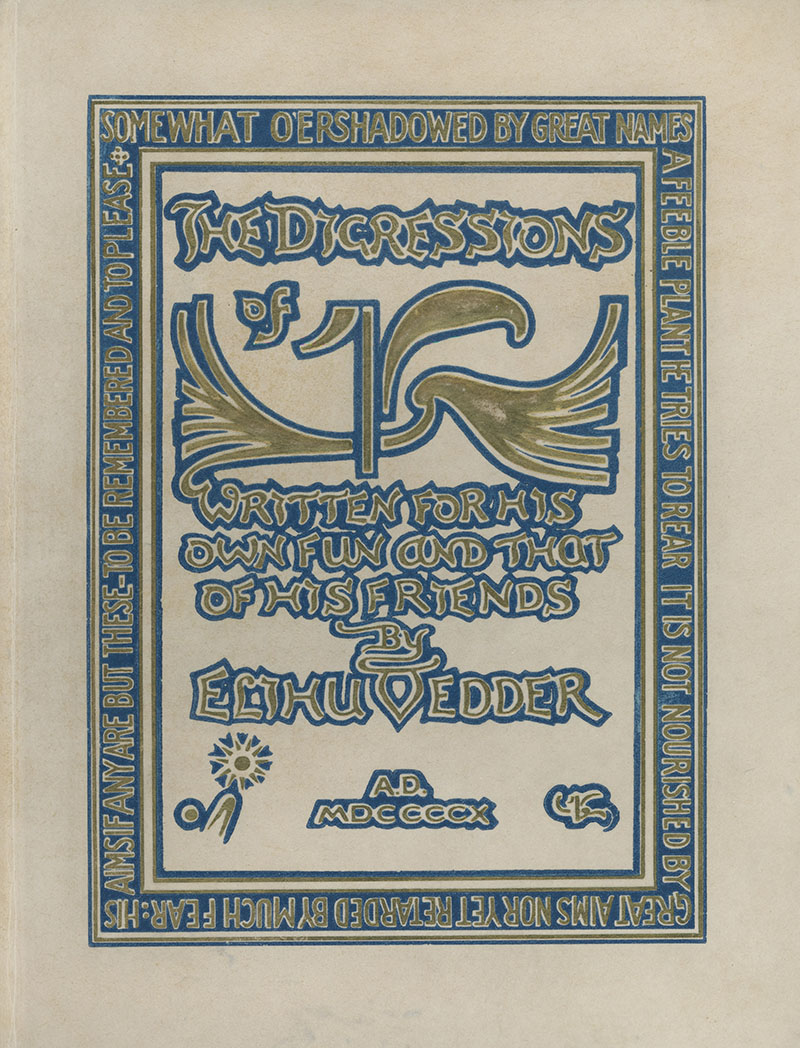
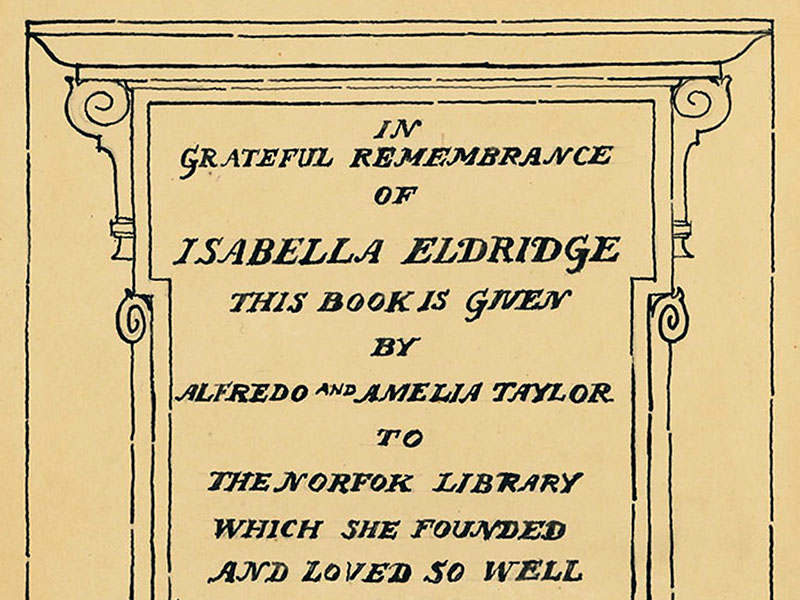
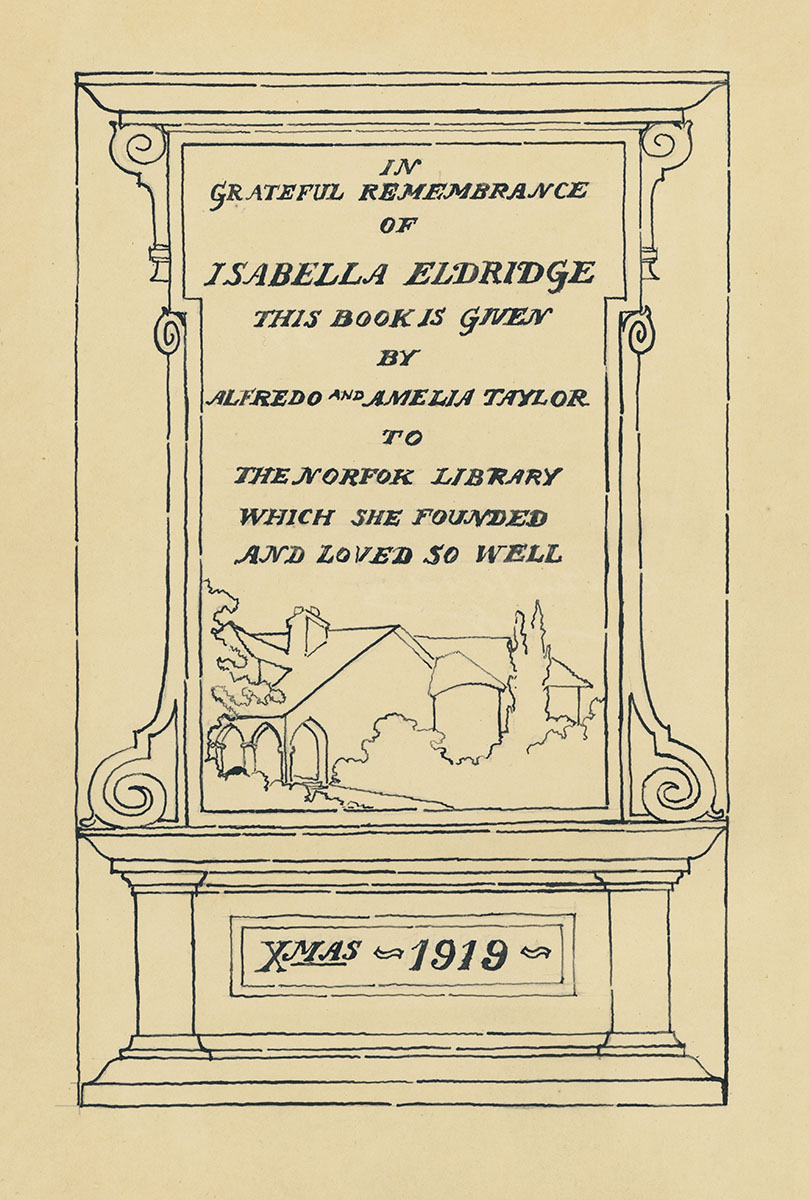
The Digressions of V is a richly illustrated book, published in a limited edition of 525 copies, signed and numbered by Vedder. The Library’s copy is number 39. The book is bound in vellum with gilt lettering on the spine and a cover intricately embossed with blue and gilt decoration. Etchings, engravings, gravures, drawings, and photographs are among the illustrations, as is a special plate unique to this edition. Remarkable is Taylor’s memorial inscription on a page just inside the cover. In pen and ink, he drew a decorative frame with a dedication to Isabella and an image of the Library “which she founded and loved so well.”
Elihu Vedder (1836–1923) was an American painter, muralist, book illustrator, and poet. He is known for his allegorical and symbolic works, derived from dreams and fantasies and painted in a highly realistic style. One of his finest works is Edward FitzGerald’s translation of The Rubaiyat of Omar Khayyam (1884 edition) for which he made 55 illustrations.
Born in New York, Vedder settled permanently in Rome in 1869 soon after his marriage. There he painted light-filled images of the Italian countryside. He made annual visits back to the States, where he received his most important artistic commissions. Among his murals are five wall paintings and a mosaic in the Reading Room of the Thomas Jefferson Library of Congress (1896–97). Tiffany engaged him to design glassware, mosaics, and statuettes for the company.
Vedder was considered among the most erudite and imaginative artists working in the late 19th century. His autobiography was popular among those cultivated in the arts, and Taylor was a natural candidate to purchase not only a copy of the book, but the fine special edition. Moreover, Taylor and Vedder must have known one another both in New York and Rome. Taylor was born in Italy, and he made frequent visits back. Although a generation apart in age, they would have travelled in similar artistic circles.
On the title page of Digressions, Vedder describes the autobiography as “containing the quaint legends of his infancy, an account of his stay in Florence, the garden of lost opportunities, return home on the track of Columbus, his struggle in New York in war-time coinciding with that of the nation, his prolonged stay in Rome, and likewise his prattlings upon art, tamperings with literature, struggles with verse, and many other things, being a portrait of himself from youth to age.” The autobiography is clearly not a dry portrayal of his life, but a joyous account of a life well-lived.
In a memorial tribute to Vedder [artsandletters.org], John C. Van Dyke wrote that the artist’s personality is fully revealed in the book: “Vedder has written his own story in his Digressions of V and happily forestalled his obituarist. It is impossible to be funereal in reading that story for it is full of humor, gaiety, and caprice. It wanders, rambles, digresses delightfully, and breaks off just when you expect him to say something serious about Rome and Raphael and academic drawing … He smiles all through the book.”
Why did Taylor choose to give his copy of Digressions to the Library and inscribe it as a memorial to Isabella? The choice was clearly deliberate, for Taylor had known Isabella well. He had worked on several projects for her and her sister Mary: a handsome cobblestone pavilion on the Norfolk Downs golf course (1906); a decorative railing on the Maple Avenue railroad overpass (1910); and an elegant fieldstone carriage house behind their residence (1915). Taylor designed the Tiffany triptych presented to Isabella to commemorate the Library’s 20th anniversary in 1909. Perhaps the most poignant evidence of their friendship is his design of the memorial plaque that was installed in the Church of Christ after her death. He and his wife Minna wrote the inscription: “Her lovingkindness overspread our town like angel’s wings.”
As we ponder a possible connection between the Vedder book and Isabella, it is the artist’s erudition and penchant for romanticism that resonates with what we know about Isabella. The daughter of Norfolk pastor Joseph Eldridge, Isabella grew up in an erudite family. Her father kept a remarkable collection of books in the parsonage, freely shared with his parishioners. Next door was Whitehouse, the residence of her grandfather Joseph Battell, whose extensive private library was so extraordinary that it was catalogued by his children. His love of literature filtered down through the generations. Isabella was educated at Miss Porter’s School in Farmington, Connecticut, where the progressive curriculum included both the sciences and the humanities.
With this background, it was natural that Isabella would build a library and gift it to the town as a tribute to her family. Not only did she build the Library, she also chose the books to purchase and oversaw the growth of the collection. “Miss Eldridge did not limit her interest to the founding of the Library,” eminent clergyman and Norfolk summer resident James Ludlow told his audience in a 1921 memorial address, “but by constant personal oversight for a generation guarded its shelves from whatever might degrade the taste and enriched them with the choicest productions of classic and current literature. Almost every writer worth reading appears among its 25,000 volumes. These were purchased chiefly by Miss Eldridge herself. He is a rare scholar who cannot here find enough to console him for temporary absence from his home books.”
Although we do not know Isabella’s personal taste in literature, reminiscences of family and friends suggest that she was indeed a romantic. We can well imagine her reading the novels of Jane Austen, Louisa May Alcott, and Charlotte Brontë; as well as the poetry of Lord Byron, Coleridge, Keats, and Shelley, all of whom were represented in the collection. Her companion in later life, Emilie Hamant, recalled that Isabella enjoyed reading the first novel in Galsworthy’s Forsyte Saga, The Man of Property, when it was published in 1906.
What is more, Isabella engaged architect George Keller to design her library in a romantic revival style. Perhaps there was a measure of Vedder’s “humor, gaiety, and caprice” in this decision. The Norfolk Library was certainly unlike any library in Northwest Connecticut at that time with its vibrant combination of colorful materials–brownstone, fish scale shingles, red tile; a picturesque turret tucked into the corner; and a sandstone owl on the porch roof eyeing people as they enter.
As William Henry Welch wrote in a memorial address, the Norfolk Library has “a certain attractive personality, a charm and a distinction all its own, which seems to enshrine something of the spirit of Miss Bella.” Just as Vedder “smiles all through the book,” Isabella was always present, welcoming and smiling throughout her beloved library.
Vedder’s book is an ideal tribute to a woman whom the Taylors considered a true aesthete, conversant in books and architecture, in history and culture. Isabella may never have met Vedder, but they shared a romantic spirit and a sophisticated sensibility of the arts.
Sorry, the comment form is closed at this time.