



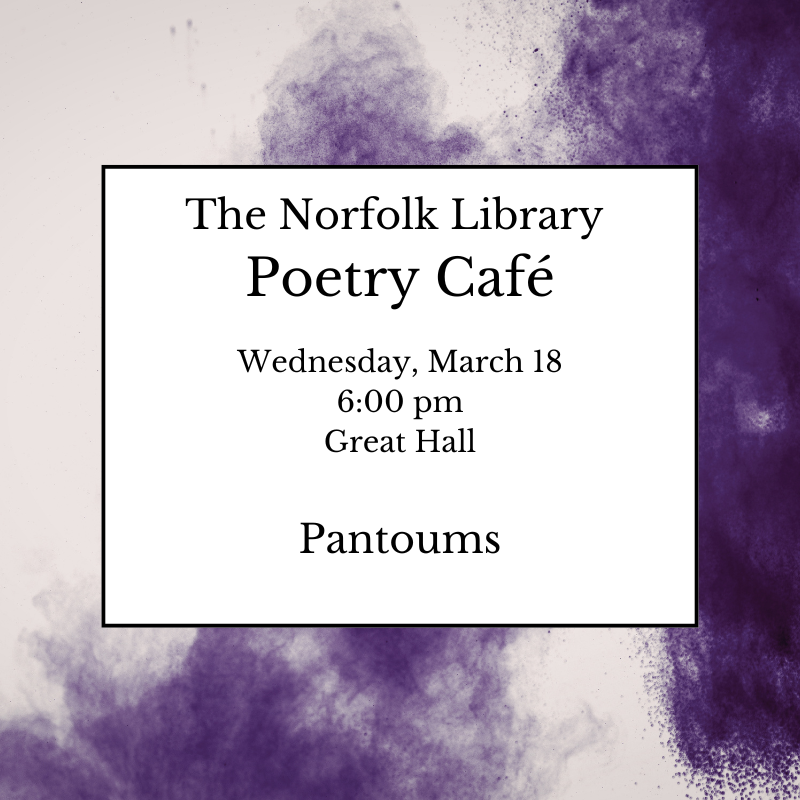
March Poetry Café: Pantoums
Join us for our monthly Poetry Café in the Great Hall. For March, we are going to write and share pantoums. The pantoum is a poem of any length, composed of four-line stanzas in which the second and fourth lines of each stanza serve as the first and third lines of the next stanza. The last line of a pantoum is often the same as the first.
The pantoum originated in Malaysia in the fifteenth-century as a short folk poem, typically made up of two rhyming couplets that were recited or sung. However, as the pantoum spread, and Western writers altered and adapted the form, the importance of rhyming and brevity diminished. The pantoum was especially popular with French and British writers in the nineteenth-century, including Charles Baudelaire and Victor Hugo, who is credited with introducing the form to European writers. The pantoum gained popularity among contemporary American writers such as Anne Waldman and Donald Justice after John Ashbery published the form in his 1956 book, Some Trees. Click here to read examples of pantoums.
Come ready to share your work or be an attentive listener, all are welcome. Please register below.
There is some debate on the origin of the phrase “Poetry Café.” Some argue it refers to the Modernists (Gertrude Stein, Ernest Hemingway, TS Eliot, etc.) sharing their work in the cafés in Europe. As spoken word poetry has gained traction and the genre of slam poetry has evolved, some trace the phrase to the Nuyorican Poets Café in Manhattan. The café was founded in 1973 by Rutgers professor Miguel Algarín and gave Puerto Rican New York poets a place to meet and share their work. Although the café was closed for several years in the 1980’s, it continues to serve as an arts center for the Nuyorican community.
Sorry, the comment form is closed at this time.