


14 Jul The Ups and Downs of Life
The Ups and Downs of Life
by Ann Havemeyer
In October 2025, a family came into the Library, marveling at the beauty of the building as most people do. When they introduced themselves as descendants of John Bailey, I knew that their family history intersected with the Library in a very special way. And I took them over to the Tiffany triptych that is mounted on the wall near the entrance to our Reference Room.
The bronze triptych, a folding three-part framed document, was executed by Tiffany & Co. of New York and presented to Isabella Eldridge on March 6, 1909, to commemorate the 20th anniversary of the Library. On the triptych’s beautifully illuminated parchment, an inscription reads: “To Isabella Eldridge, founder of the Norfolk Library. After twenty years enjoyment of her gift we present this bas relief of Stevenson as a token of our gratitude.” The bronze bas-relief of Robert Louis Stevenson was modeled by Augustus Saint-Gaudens and hangs in the Reference Room today. Inscribed on the triptych are the names of those townspeople who contributed to the gift.
The list is remarkable, ranging from well-known summer residents to Norfolk schoolchildren. Among those listed are: Dr. Edward Quintard, personal physician to Mark Twain; Isabella Beecher Hooker, women’s rights advocate and sister of Harriet Beecher Stowe; Professor Michael I. Pupin, Serbian-born, Pulitzer Prize-winning physicist; Frank J. Goodnow, President of Johns Hopkins University; Frederick M. Shepard, President of the Goodyear Rubber Company. Among the school children listed are the children of African-American John Bailey.
The Bailey family figures prominently in Norfolk’s history. Both John and his brother William were stone masons and likely helped build many of the structures that were erected during the early 20th century building boom as summer residents moved into town. John married Flora Foote of Salisbury on November 24, 1894, and they had five children before Flora’s untimely death in 1907 at the age of 35. The Bailey children attended the West Norfolk School. John Howard (age 14), Sarah (age 12), Flora (age 11, known as Flossie), Ellen (age 9), and Charles (age 8) are listed on the triptych.
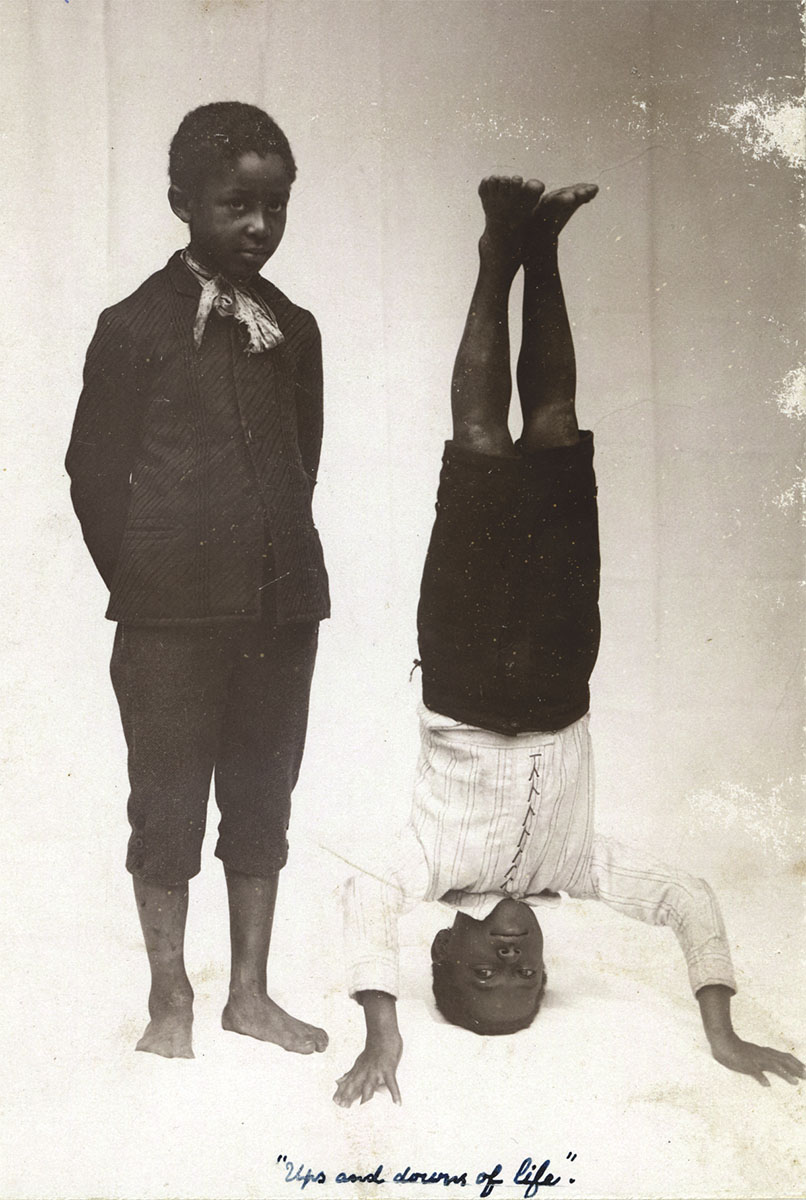
The Bailey children appear in some of Marie Kendall’s photographs as she documented life in Norfolk at the turn of the 20th century. Well-known for experimenting with multiple exposures, Kendall entitled one photograph of a Bailey “The Ups and Downs of Life.” With racism rampant in the early 20th century, perhaps there was a double meaning in this title? When Isabella died in 1919, Dr. William Henry Welch wrote: “Miss Bella desired the library to be of the greatest possible service to all … without distinction of race, creed or condition.” The list of names on the triptych suggests that the Library was a welcoming place to all Norfolk residents. But can we be sure African Americans such as the Bailey children felt welcome in the Library?
We do not have first-hand accounts of the treatment of African Americans in Norfolk at this time. In his 1900 History of Norfolk, Theron Crissey devoted a chapter to African Americans “of worth.” Deacon James Mars (1790-1880) was described as “the best deacon in town.” He had been sold at the age of 8 to a Norfolk farmer in 1798 and, after publishing his Autobiography, returned to Norfolk later in his life. Bilhah Freedom, a cook, was so beloved by townsfolk that they placed a marble monument at her grave in Center Cemetery with the inscription “Of African and princely descent, of queenly yet deferential demeanor.”
Yet we must read between the lines. Although Crissey wrote that “few persons in the whole history of the town, regardless of name, race, color, or condition, have been more respected and loved than was Aunt Bilah,” he goes on to refer to her as a racial caricature: “In the south, she would have been to everyone Mammy.” James Mars’ brother, Rev. John Mars, referenced racism more directly. Crissey quotes Mary Oakley Beach, who reminisced that John had lived with her family when she was a baby: “I used to pat his face as he held me, as I have been told, and he would say, “My black skin does not make any difference to her.”
The 20th century brought increased racism. John Howard Bailey was the only African American from Norfolk to serve in World War I. He was inducted into the National Army on Aug. 1, 1918, and served in the 445th Reserve Labor Battalion. More than 160,000 African Americans served in labor battalions during the war. Military officials assumed that Black men would make poor soldiers and therefore assigned them to non-combat battalions. They labored under white officers and were often treated poorly, confined to camps, denied passes, and given reclaimed clothing. One African-American soldier in John’s battalion wrote to the Office of the Secretary of War in 1918, describing what was likely also John’s experience. A transcription reads:
I am writing to you today because you can do some good. We have a mean lieutenant. He is a Negro hater. It is 600 men, just the same as slaves. You try not to have any slaves in your army.
[Original quoted in Civilians in a World War, 1914-1918 by Tammy M. Proctor, NYU Press, 2010]
John Bailey was honorably discharged on March 13, 1919. He returned to Norfolk and was living here when the War Memorial was built, erected in 1923 to commemorate those who served. Each Norfolk soldier’s name was inscribed on a bronze plaque. Each soldier, except John Bailey. Whether the omission of his name was an oversight or an intention, we will never know. As part of the monument’s restoration in 2023, John H. Bailey’s name was added.
Another Bailey family experienced racism after moving to Norfolk in 1924. When she was a young girl, Martha Bailey came to Norfolk from Virginia with her parents, John Edward and Jeannette Bailey. As an adult she left Norfolk to pursue a career as artist and teacher, but returned to town for the last years of her life. Many of us remember Martha Bailey Davis, affectionately known as Maba. Her deep alto voice rang true in the church choir, and she exhibited her artwork at the Library in March of 1983. She died in 1997. This is her family’s story:
“My father and mother came to Norfolk in 1924. I was four years old. John Edward Bailey was a skilled blacksmith and wheelwright. He worked for a short time for the ‘Norfolk Village Smithy’ on Westside Road. Because of Bailey’s expert work, he was in great demand which caused professional jealousy on the part of his employer. Soon this situation became intolerable, and my father sought financial backing to open his own shop. In 1925 this was unrealistic dreaming for a Black man in Norfolk. His efforts were blocked.” John found work as a groom and then as a butler. He retired and moved to Danville, Virginia, in 1957.
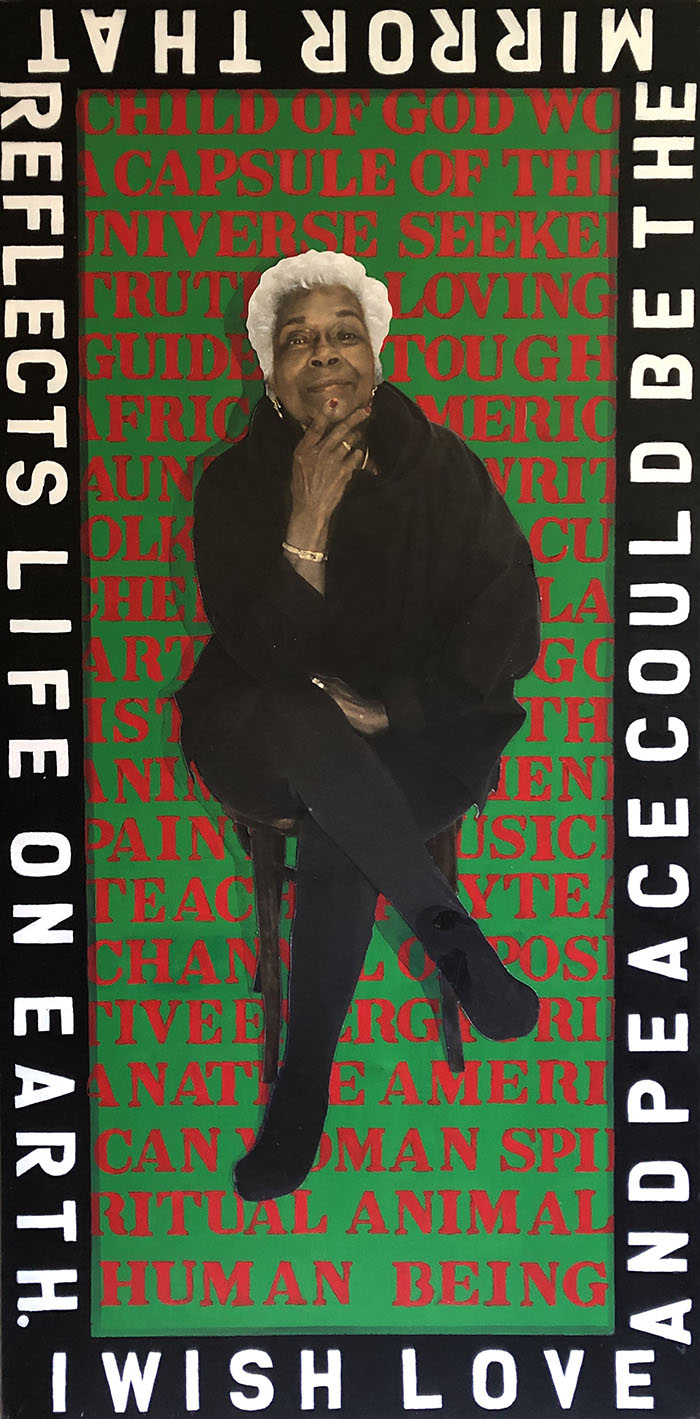
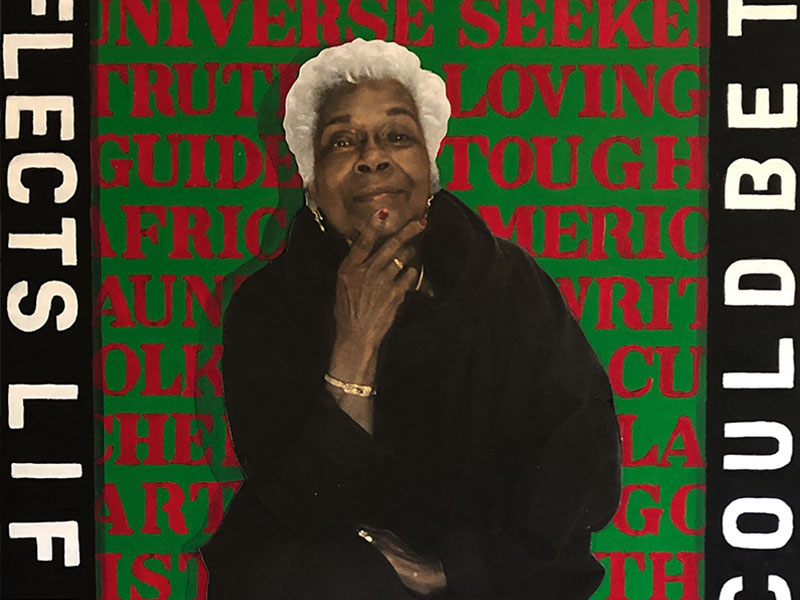
Maba Bailey Davis, 1995. Painted photograph by Peter J. Ketchum, one of the series of painted photographs of Norfolk residents exhibited at the Library. The artist asked the subjects to describe themselves in words that surround the portrait.
What enticed Maba to return to Norfolk? To her, it was a place that felt like home: “My family’s years in Norfolk were hard years but full of love, nature, beauty and learning. Learning about life, people and animals (all kinds) that inhabit the earth. I have come back to live for a while in the town that feels like home to me. For this is where I learned to know the reality of the only thing that matters in living on planet earth—love.”
Sorry, the comment form is closed at this time.