


14 Jul Meet Me at the Libe
Meet Me at the Libe
by Ann Havemeyer
2024 marked the 50th anniversary of the Library Associates, an outstanding group of volunteers whose dedication and service to the Library has brought it to back life as a cultural center. With monies raised primarily though the annual book sale, the Associates fund all cultural programs—including concerts, films, lectures, and children’s programs—open to the public, free of charge. The Library is a busy place these days, as had been the vision of its founder, Isabella Eldridge. When she built the library in 1888 and gave it to the people of Norfolk, it was her wish that it would be more than just a library. It would be a gathering place for the community. And during her lifetime, she made sure that it was.
Imagine it is 1891, and you have come to the Library to hear a lecture on Italian art given by noted art historian and summer resident Professor Arthur Frothingham of Princeton University. As you enter the building, you pass a miniature gondola sitting in a tank of water. The Library is decorated with floral garlands in the colors of Italy—red, green, and white—festooned around the mezzanine railing, interspersed with Roman shawls, aprons, rugs, and mats. A large photograph of the Colosseum is draped with Italian flags. After the lecture, the audience is treated to red, green, and white Italian ices shaped like guitars and mandolins, furnished by Maresi Confectioners of New York, while a troupe of Italian musicians play their mandolins. This was one of many cultural and educational events Isabella produced that made the headlines of the Winsted Evening Citizen.
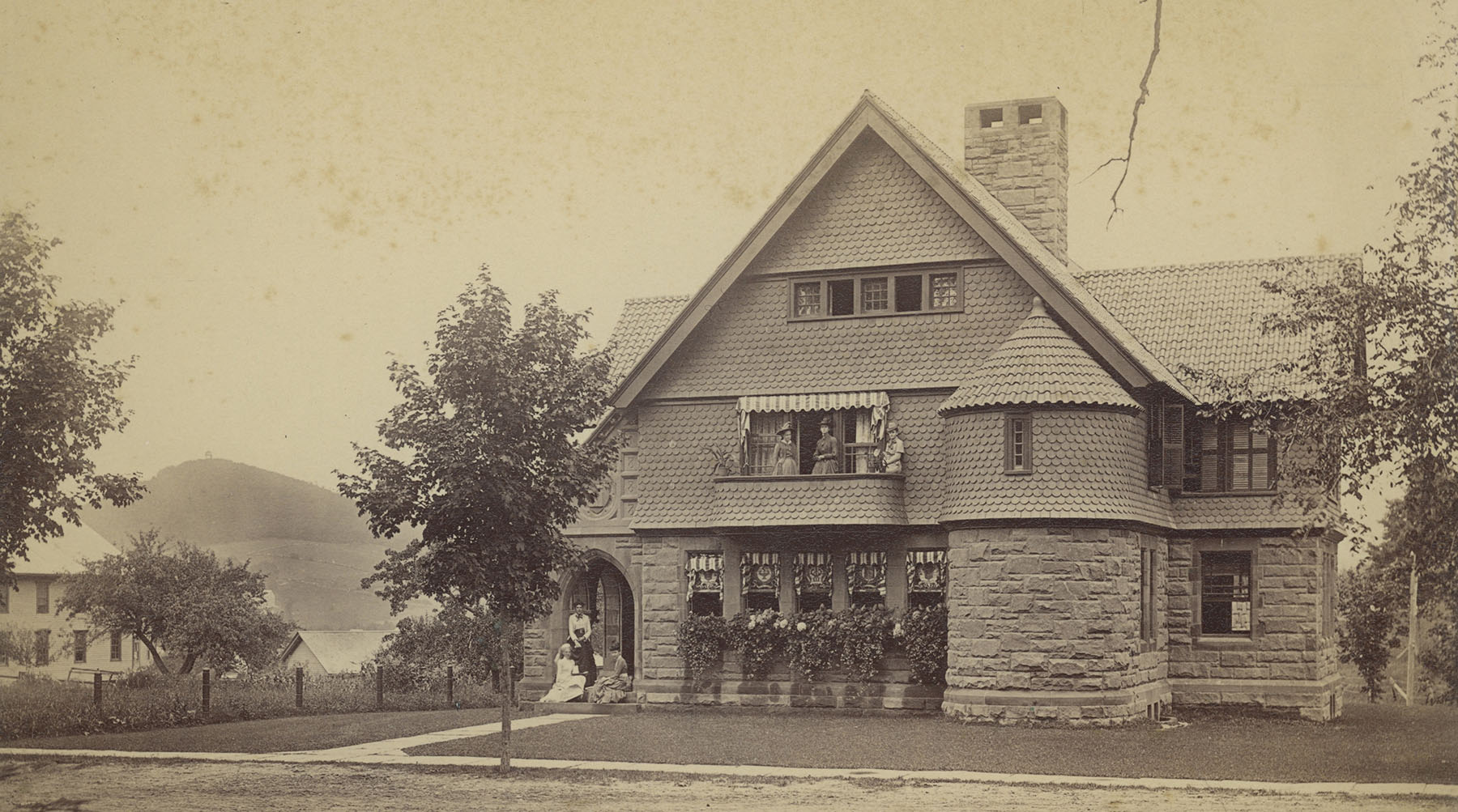
Marie Kendall photograph, ca. 1890
The Library quickly became a place of gathering for the entire community, old and young alike. “Our library is unique,” recalled Karolina Kendall, daughter of Norfolk’s late nineteenth-century photographer Marie Hartig Kendall. “A wealthy woman gave it to the town and equipped it nicely. It has a conversation room where people may visit. It is always warm and smells good! Young people had a good time at the library. There was so much to do there – old bound St. Nicholas magazines that had to be read on the spot; art books too large to take home. The favorite town saying was ‘Meet me at the libe.’ And everybody did.” By 1909, the twentieth anniversary, the number of annual visitors had grown to 55,000. In 1911, Isabella added the Great Hall, doubling the size of the Library.
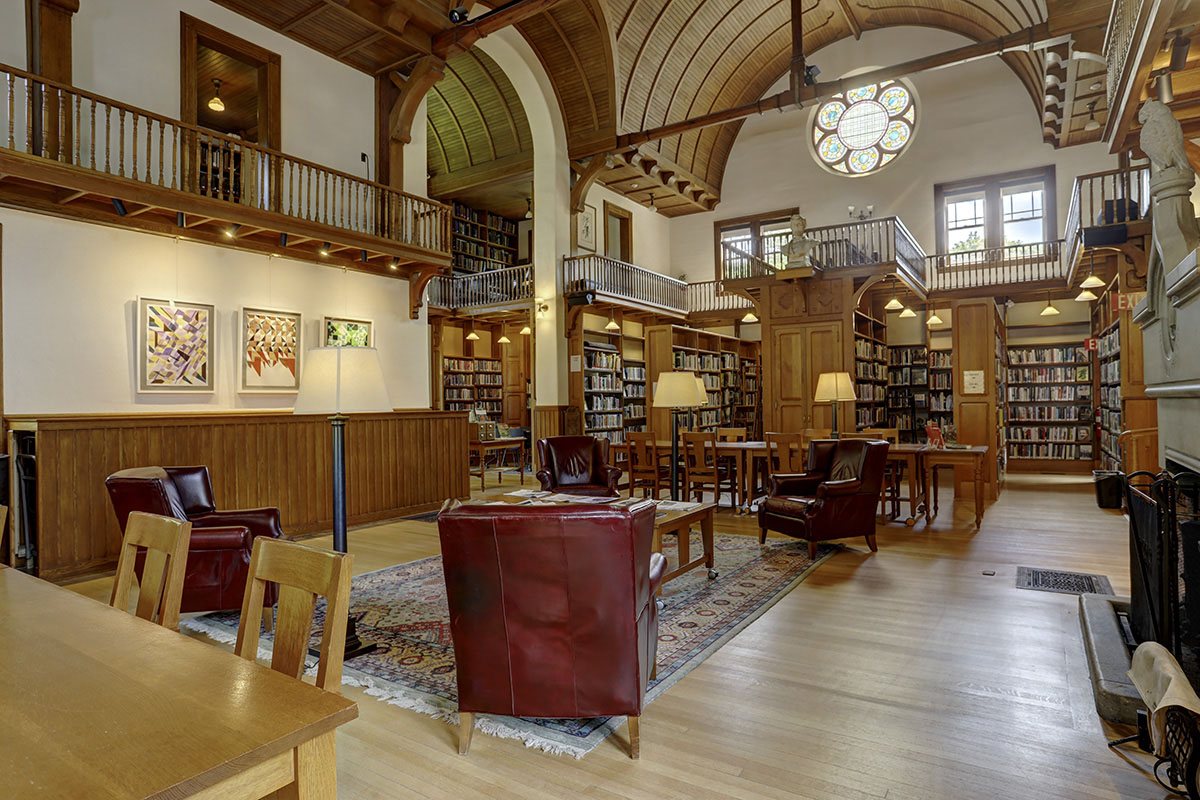
Norfolk Library Great Hall
Isabella died in 1919. By then, World War I had taken its toll on library activity, and for the next 55 years, the Library was mostly silent as the Great Depression and another world war made the days of cultural entertainment a distant memory. Fast forward to 1974, when the trustees decided it was time to bolster the Library as a community center. Many years had passed since Isabella had taken the role of impresario, and no one was prepared to devote the necessary time to what was considered a Herculean task. Where once one woman had done almost everything by herself, and at her own expense, now even a committed board could not keep up with all the work necessary to run a thriving library: managing the building and grounds, the staff, the collection, the finances, the programming, and fundraising for much-needed financial support.
Trustees Tibby Robinson and Martha Walcott took the lead. Both felt that the Library would benefit greatly from a series of lectures, art exhibits, and concerts. To this end, Martha gave her Steinway baby grand piano, still in use today. The two women envisioned a separate group that would schedule and host regular cultural programs, open to everyone, free of charge. They began to make phone calls throughout the community, and a group of ten Associates had their first organizational meeting in June 1974.
The Associates had very little money to begin with, barely enough to give concert musicians an honorarium and certainly not enough to purchase chairs to seat the audience. So the group decided to have a book sale. That first sale took place on August 28, 1976. Donated books were sorted in a room on the second floor, and a few tables were placed on the lawn in front of the library. The sale raised $650.
The book sale grew dramatically. For more than two decades, Hatsy Taylor was the driving force for the sorting, storage, transport, and sale of books. Today, the annual book sale is supervised by Hatsy’s daughter Bridget with the help of over 90 volunteers. It is truly a community-wide effort and a major fundraiser for the Associates. Hours before the sale starts, a long line of dealers and buyers extends west along Route 44 waiting to get in. It is considered one of the best book sales in Southern New England.
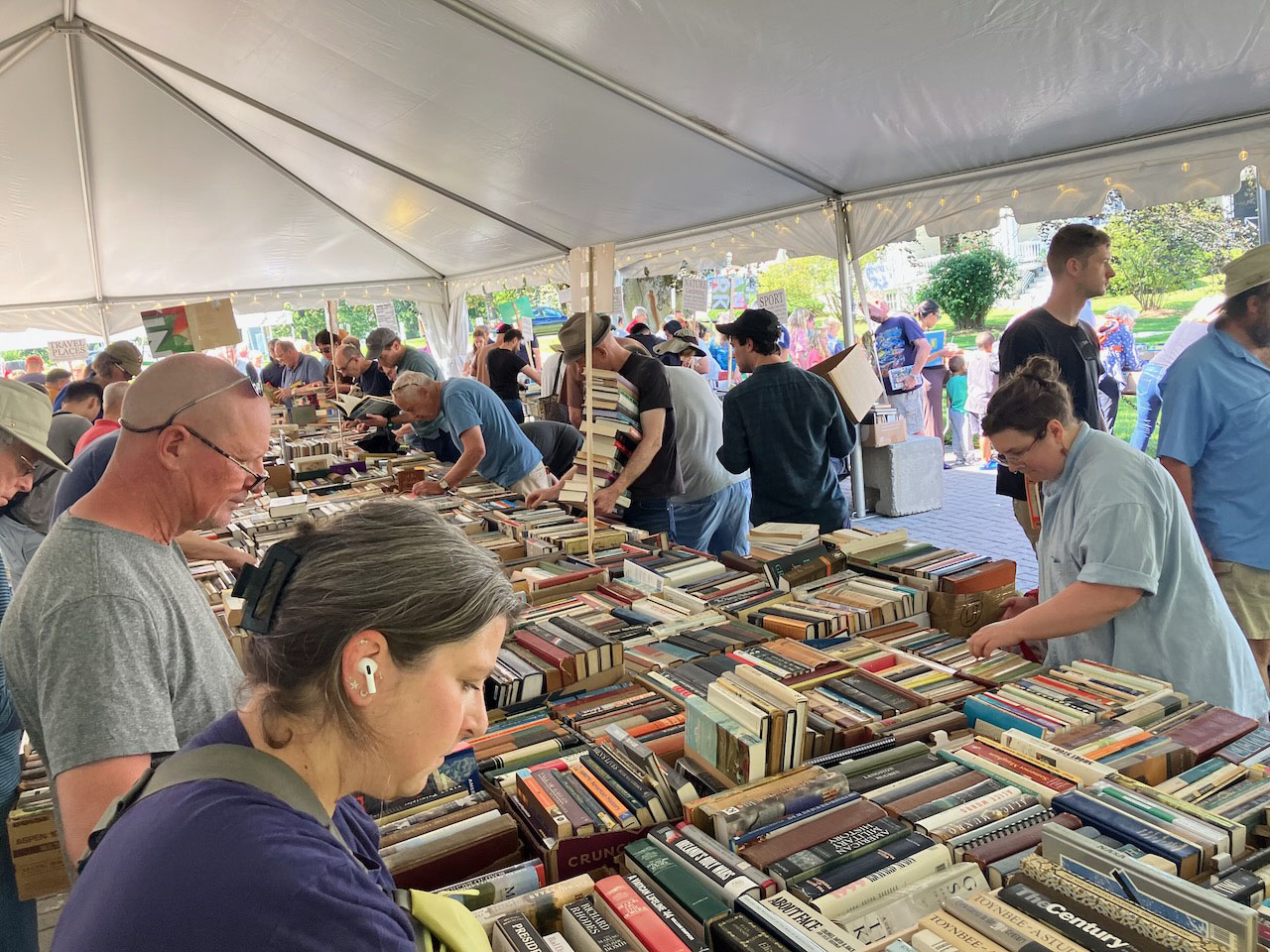
Annual Book Sale, 2025
In the 50 years since the founding of the Associates, they have organized and funded a wide variety of cultural programs, concerts, films, and lectures, bringing Isabella’s vision back to life. The first art exhibition was held in 1974 and, since then, over 250 artists have shown their work, with artist receptions hosted by the Associates. Traditions have been established. The Associates organized the first carol sing in 1979. Friday afternoon fireside gatherings were held in the Great Hall and still are today. An after-school Corner Club and Summer Reading program for children was established. The tradition of hosting a lively evening of Irish music for St. Patrick’s Day began in 1993. Mark Scarbrough’s popular book group is now in its 15th year.
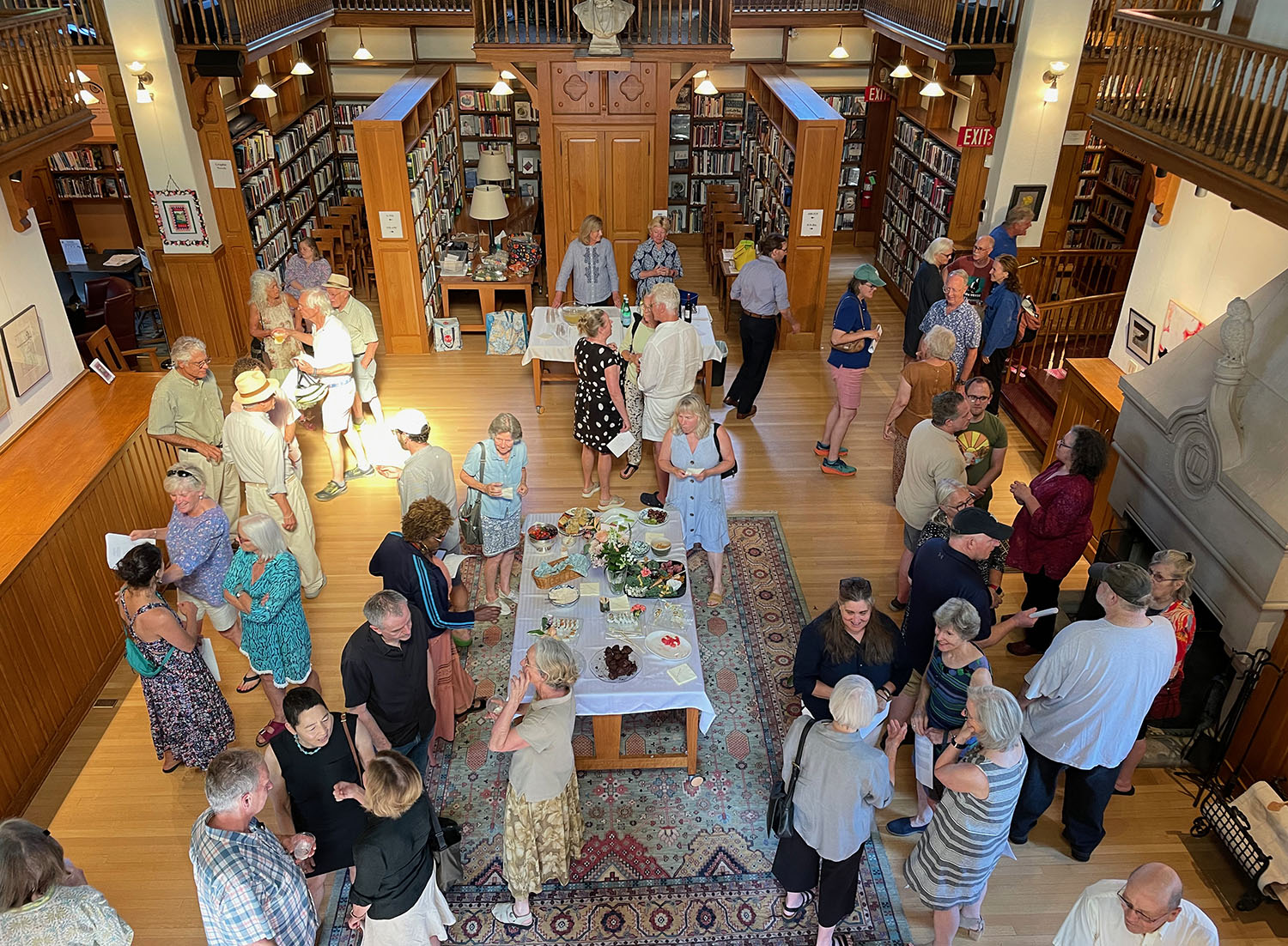
Art reception, 2024
In 1987, library director Louise Schimmel suggested that the Associates, an all-women group, consider the addition of men. As recorded in the Minutes, it was decided that such a radical move not be made in a hurry. The Associates took their time. It would be another 17 years before men joined the group in 2004. David Davis was the first. By then, the Associates had officially become an independent 501(c)(3) corporation with bylaws and a mission to broaden the outreach of the Library and raise funds for the purpose of enhancing library services and programming.
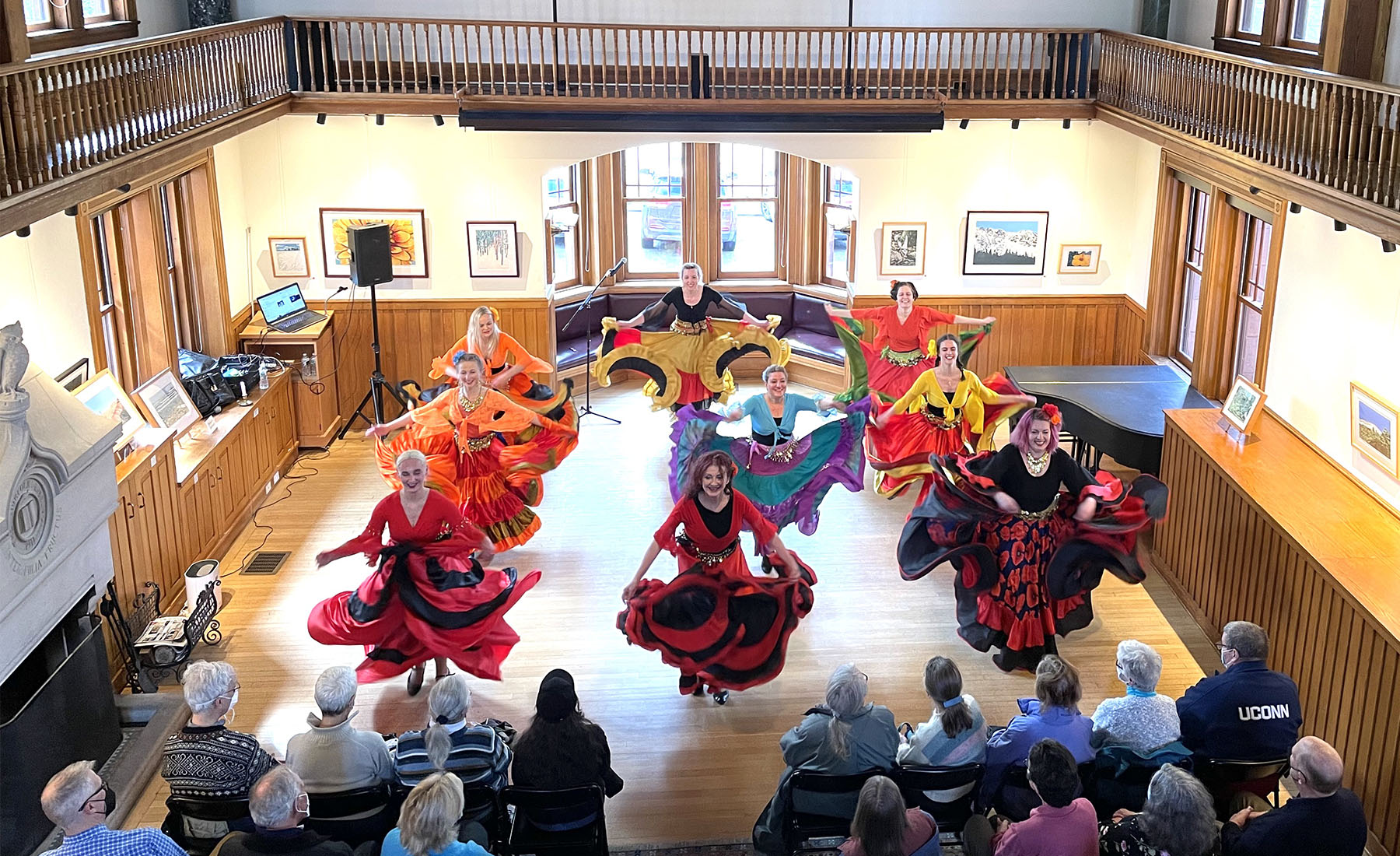
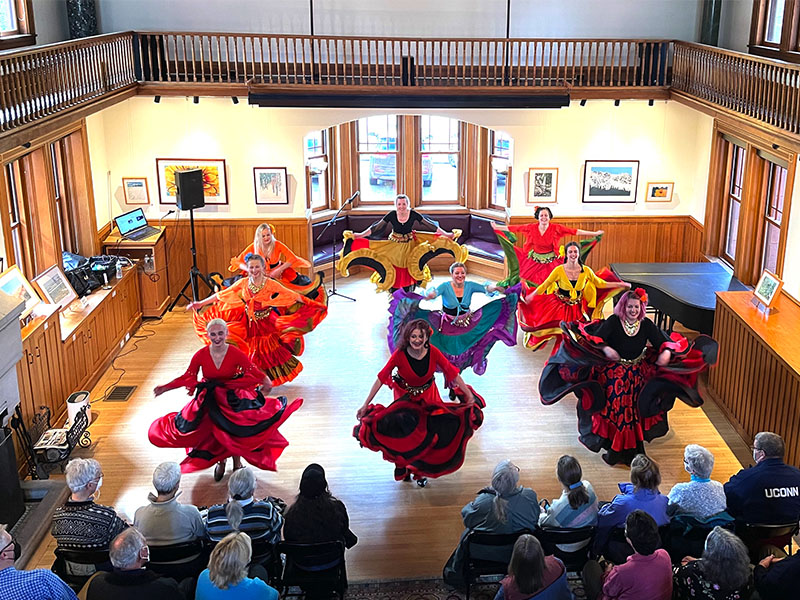
Ukrainian dancers, 2022
With increased funds, the Associates have undertaken special projects over the years. In 1995 they funded the preservation of the Library’s historic scrapbooks. Full of newspaper clippings dating back to the nineteenth century, the scrapbooks are indexed and still used by researchers today. The Associates were also able to make significant contributions to the Preserve the Past for the Present capital campaign to restore the Library and its red tile roof in 2015, and to the renovation of the Children’s Room in 2018.
Sorry, the comment form is closed at this time.